Friday, June 21, 2013
Keterkaitan Model Sistem Dinamis dan Game Theory (1 of 2)
Tuesday, November 29, 2011
Prison System Mechanics
we knew "Everyone is guilty, no one is innocent, there are merely varying levels of guilt in this entire society", however there are some crimes or action that is more than just lies or sarcastic words, and there are laws and instruments in place to prevent such an actions propagating within society. One of the instrument that we are going to observe is “Prison System”. Ideally, all the bad guys/girls (I’m not a sexists :P) should be kept inside and all the good guys/girls should be outside, although that is not always the case.
Let us try to model the society and its properties
Good guys/girls (GG) have properties:
a. GG help increase economy, they are the backbone of positive economic output
b. Economic efficiency will be increased when GG meet another GG, it is like “trust” based society, when people trust each other, the cost of overhead in economy decreases so economy runs efficiently without disallocation of resources. So let say this is a form of social capital.
c. GG pays for the prison system (let say there is a form of taxation, say “prison tax”)
d. GG may occasionally mutate to BG, there are many drives to do so.
e. There are GG that might behind bars though, however we shall assume the number is very small compared to BG that were outside of bars.
Bad guys/girls (BG) have the following properties:
a. There are two types of BG, they are the one that is "inside the bars" and "outside the bars". For example, "GG turning into BG" can also be classified as "BG outside the bars", they should be put into prison to ensure efficient society.
b. BG outside bars may help increase economic output in short run, through unsustainable economic process, like smuggling and selling narcotics.
c. BG outside bars may also reduce economy, by reducing economic efficiency and reducing social trust capital.
d. BG might kill GG in the process, thus reducing economic output.
e. BG “enjoys” prison system, which burden the economy. The terms "enjoys" means that they are producing below their potential output.
f. BG might kill BG during their stay in a prison system.
g. BG may increased their skill and cruelness when they met other BG, they may share tricks and know each other to form some group, it like some kind of university for the BG.
h. BG may occasionally mutate to GG (although not many), usually once a BG will always stay as a BG, and it’s almost like a curse.
Government & Prison system has the following properties:
a. Prison system is public goods (can you explain?), although lacking the characteristics of public goods, such as non-rivalrous, which means that consumption of this good by anyone does not reduce the quantity available to other agents and non-excludable, meaning that it is impossible to prevent anyone from consuming that good.
b. Prison works like a “grease” that is required to make the economic wheel rotate at their optimal efficiency. But, in order to erect prisons, establish law institutions, pay the guards and building maintenance, give the bad guys food to eat so the good guys can go to work safely and the bad guys stay inside and do something else requires quite a lot of resources.
c. An industrial-complex based prison system can be a temporary solution (incarceration, where BG inside prison forced to do work / labor), might help GG in reducing prison maintenance cost, however this might lower BG chance to get out of prison (slavery-like system) because the warden have the incentive to keep their "workers" inside. Such prison system may be viewed by "BG outside bars" as unfair and might increase their incentive to avoid being imprisoned or captured by police.
d. A weak and corrupt justice institution will poison the society, GG will view that being a BG or having BG job is more profitable, because they can simply pay some penalty cost and stay outside bars.
e. Once Prison system is flooded beyond its optimal level, BG may cause fear to GG and society at large. Once there is too many BG in the society, the orderly society may collapse into chaos.
f. The amount of conversion rate between GG and BG is affected by:
i. Increasing the number of police
institution (increase detection rate at the cost of more
taxation from enacting such a system). This may also potentially flooding the
prison system.
ii. Increasing the severity of
punishment, (increase the element of punishment, at no cost,
this may increase the element of sadistic and the element of smartness of
BG, whenever BG trapped in no-win situation, they
would rather die and do some desperate attempt to prevent being
captured).
iii. Early Education, this might increase society capability to increase skill to produce and create awareness of law (reduce GG incentive in becoming BG).I don’t have the equation yet, but the simplistic model below should capture all the element I have stated above, and it should be possible to derive a model for all of this.
Kindly give me inputs or insights on my statements/assumptions above.
Thursday, December 23, 2010
Input Output Table Analysis using PyIO ( for Large Matrix )
Actually you can use Matlab, Octave or mathCAD to do this, but I believe you would require more time in learning the entry command, matrix operation, balancing the table, do data transformation back and forth, etc. You wont like it, trust me !
So I decided to give PyIO a go and installed this software on my Vista 64-bit, 4 GB Memory. MS Excel is not required, but it is nice to have. I do the following to 2005 BPS 66 x 66 sector operations:
Tested and Working:
1. Sector aggregation,
2. Leontief Inverse,
3. Ghoshian Inverse,
4. Impact Analysis,
5. Output, Input, Income, Employment multiplier,
6. Key Sector Analysis (Forward & Backward Linkage), (This is imperative)
7. Multiplier Product Matrix Analysis, (This is interesting)
8. Extracting method (Removing 1 sector from the economy,
9. Push-Pull Analysis (Difficult to understand, various probability),
10. Field of Influence
Not yet tested (but it should be working though):
1. RAS update
2. Output Decomposition
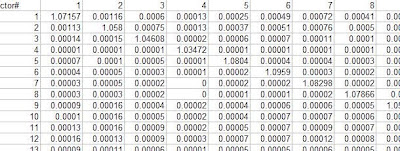
Basically everything works fine, the result can be chosen, between "Interactive Excel Data Entry" or "Tab Separated Format". I often choose the later. However I did encounter serious problem when I inputted a 175 x 175 matrix. The matrix wont showed-up (as shown in the pic below). After further inspection into the code, I saw what may have caused it, apparently the windows size is hardcoded so that the horizontal grid is maxed out to a just (100-3) cells = 97 cells, arrgghh... awfully pity !

Crawling to various URL in the internet (Google search power is getting worst and worst these days, geezz..), I see a lot of junk of information regarding PyIO, no solutions of how to overcame large matrix calculation limit. I also have tried various ways from downloading py2exe apps, trying to re-write the code, but to no avail. Tired of trying, I abandon the idea of using PyIO for calculating large matrices, but that is until recently, when I uncovered that I can large matrices calculation with it..
So How?
Just use PyIO older version ("Lowtek rulez eh ?"), the one with command line, this older version is much more powerful than you think. You can download it from here: http://www.real.illinois.edu/pyio/OldversionsPyIO/pyio.zip
In the future, it will be hard to find them all, so I took the initiative to preserve this PyIO release and pack them into one zip consisting of:
- PyIO version 1.0
- Python-2.2.3
- Mark Hammond win32all-152.exe
- Numeric-23.0.win32-py2.2.exe (no longer available)
- Some PDF/Whitepapers mentioned in the PyIO manual
- Indonesian 2005 66x66 sectors and 175x175 sectors (Producers Prices), Employment, Income. (provided as-is, accuracy is not guaranteed)
You can download it from here: (multiple download link will soon be available). Credits goes to the respective apps programmers/contributors.
Instructions:
- Install package #2, #3, #4.. (see above)
- Install package #1, all into the same folder
- Copy your input file (in this case 175sector.txt and/or 66sector.txt into that folder too,
- Start -> run -> cmd
- Navigate to the folder, using multiple cd command
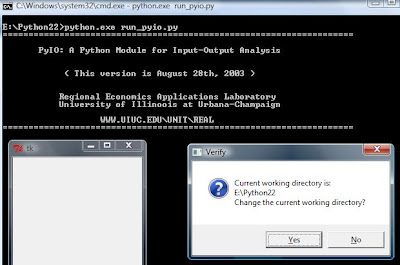
- type python.exe run_pyio.py, a screen like this should appear:
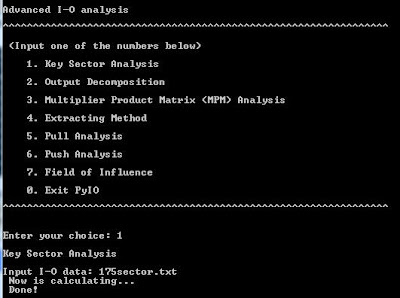
- Once you are in the menu, just type what you want to calculate, for example for "key sector analysis" then type "3" and then type"1" , enter the file name "175sector.txt", dont use excel output if you are calculating a large matrix because the result will not appear instantly, so just use the text file.
- Rename the output file *.out to *.txt, and use Excel to open it. All cell
should be displayed nicely.
Wednesday, December 15, 2010
Economics of Happiness
“For 60 years, Gross Domestic Product, or GDP for short, has been the yardstick by which the world has measured and understood economic and social progress. However, it has failed to capture some of the factors that make a difference in people’s lives and contribute to their happiness, such as security, leisure,income distribution and a clean environment–including the kinds of factors which growth itself needs to be sustainable.."
- Joseph Stiglitz, “Progress, What Progress?” (March, 2009)
I'm not going to belittling GDP nor GNP as an important measures of an economy, but I should remind us, including me myself that we sometimes forget that once again Economics is never about a profit maximization nor production maximization science, it is a utility maximization science.
I always dreamed to go to NZ, admiring its beautiful landscapes, winds and cattles. And then I realize, the urges came from my expected happiness, that believes the following:
1. Money do affect happiness, at least to a certain point / cut-off value.
Beyond a certain level of income, money has little relevance with my happiness, in
fact giving me more money will give me negative happiness ?Why ? Because more money will make me worry of economic jealousy from neighbours that will attempt to seize my money/assets forcefully even if I make my own fortune painstakingly, thus giving me an overall negative happiness.
2. Money doesn't buy me relationship, health, leisures and freedom.
Although consumerism gives people a short-run happiness to some extent, but the same economic activities that support the consumerism, drains many happiness, for example excessive work cause divorce, bad health from pollution or overworking, reduced leisure and creative activity and globally it reduce freedom (long-run happiness). This is subjective but it still can be quantified through social metrics, such as number of marriage and divorce, mental and physical health disorder records, leisure sector activities, specific crime rates, ecological deteoriation, etc.
3. Unimportant activities disallocated Resource required for sustaining life.
Why do I need to cut down forest, killing all the animal in the process, just to build a timber processing plant, where it produces carbon emission, polluting surrounding environment, just to provide woods for exported furnitures.
4. Happiness is difficult to measure, but it is not impossible.I know that GDP/GNP is easier to calculate, convert and compare, thus it is portable statistics to make analysis of, and Happiness is subjective and can be used as political tools by the government to strengthen their legitimacy. But isn't it better to calculate something vague using imprecise tools rather than using wrong tools. it's like using GPS (precise tools to measure position) to approximate temperature (applied to measure the wrong subject) ).
Happiness Snapshot from Russia :
And also there are growing concerns among big countries to apply and incorporate Gross National Happiness (GNH) or GDH or whatever it will be called, into their national target, something that Bhutan had already done since 1972. According to Associated Press, Nov 15, 2010:
- "There is growing international recognition that to measure national well-being and progress there is a need to develop a more comprehensive view, rather than focusing solely on gross domestic product"- Jil Matheson, UK.
- French President Nicolas Sarkozy ... two years ago asking two Nobel prizewinning economists to devise ways to measure quality of life factors in addition to simply economic factors when France it studying its policy options.
And also some facts that although GDP have increased, happiness is decreasing :
- American Journal of Psychiatry the rates of depression across almost all demographic groups have risen in the United States over the past 10 years, with major depression rising from 3.33 percent of U.S. adults in 1991-1992 to 7.06 percent in 2001-2002: In other words, it has more than doubled.
So.... Does Money still "Granger Cause" your Happiness ?
Sunday, November 28, 2010
Dual-Competitive Government
This may be a silly idea ("Impossible") or may took many years to implement", here's how it will go...
Warning: This is a Thought Experiment, spare me the laughter... :)

The present Governmental Weakness
- The current government (Executive) evaluation process took a long time, 5 years or more to make the leader submit their self-evaluation. It will be to late for change to take place. We need adaptive Government with specific Key Performance Indicator which can be evaluated at any point of time by the House of Representative.
- The ruling government once elected was difficult to be changed. Furthermore, some people will become upset if their leader changed before their time is up. We need a system that will Zeroing the unneccessary cost of political change.
- There is strong suspicion that after being elected, the Executive in their 2nd to 3rd year of their ruling time will collect fortune for themselves , while in the 4th year busy polishing their record in order to win the next election. We need a system that force them NOT to do this or at least make it difficult.
- It's difficult for the Executive member to voice their "official" dissenting opinion/concern that serve as self-reflection and early notification for the House of Representative to embrace a "heads-up" signal when crisis arrived. We need a system that promote self-reflection mechanism without the fear of being fired or marked as rebel.
- Some leaders are "Leader in Crisis", typically have strong recovery management, while other "Leaders in Growth", typically have many creative ideas to make new breakthrough. We need a system that facilitate a means for both type of leaders to co-exist.
- There are condition where HoR doesn't do what people concerned of, in this case people can do their own "civil disobedience" and therefore crippling some of the KPI which related to a specific Leader governance that they dont like, so it will be switched to other Leader. They dont have to wait for 5 years to do it.
The Implementation
- The Presidential Candidate will have to campaign from the beginning stating whether they are favoring in the side of "Growth" or "Crisis", they must to pick only one. (And also their program, target, but that's not what we mainly concerned of right now).
- In the election, People will be asked to pick two Presidential Candidate, one from "Growth" and one from "Crisis" (ideally from different party, or different interest, and independent), simply put they will be asked to whom they will be convinient to be lead during Good Time and Bad Time. (I do strongly advocate that not at presidency level but at ministrial level, but I will accept this adjustment for simplification)
- Once elected, both of them (Leader in Growth and Leader in Crisis) will be given a "President" status (for a simple reason, that people have elected them), any Institution within the country will treat them as equal. HoR, based on current KPI, will appoint which President will be in charge first. (Is the country in Crisis or in Growth?)
- When Leader in Growth is in-charge/active, the Leader in Crisis may not protest anything, their job is simply as an observer (listen and report) and make report to House of Representative about their concern, so that the House of Representative may call the current active President.
- Leader in Crisis may not openly criticize, threat, undermine, hinders, remove Leaders in Growth to perform their duties, and vice versa. Such attempt can be considered as Inconstitutional by HoR. Leader in Crisis may only voice their concern to the HoR (request a meeting) and to the masses but it can be done once every several determined months, that if and only if the KPI had an strong indication that may lead toward Crisis. It is HoR job to decide whether to make Press Release or not regarding the meeting content.
- Each of them are required to state their KPI (low and high), Programs and Ministers. For example: Leader in Crisis will set their Economic KPI at 1% - 4%, while Leader in Growth will set their KPI at 3% - 6%. The intersect lies within 3%-4% boundaries. The job of House of representative is to set the median value, for example 3%.
- Leader in Crisis during "his/her inactive time" is guaranteed of equal access to information for every ministrial report. Every accsss of information is replicated between both Leader, it works like a carbon copy. Ministers must submit their report to both President.
- Suppose the economic growth drop to 2%, below the median value (3%), then the Leader in Crisis will automatically takeover the economic responsibilities and the condition #5 is reversed (Leader in Growth will be temporarily discharged/relieved of duty), Leader in Growth may not protest anything. The condition #5 is reversed again if economic growth is above its median value (3%), at 4%.
Interesting Features of this kind of Government
- Swift and legal transition in the Executive Body,
- It shifted the President power from monopolistic to oligopolistic, so assuming both of them craving for power, it will be a competitive government.
- Allow for both conservative and progressive style of government to co-exist.
- Different skill-sets is required for different conditions, and we let the people choose what the best for them in Bad or Good Time.
- There is disincentive for Executive to not performing well, they will be out of job and power.
- Self-Critic/Assesment can be conducted at any point of time without the fear of being fired, left hands know what right hands going to do.
- Still maintaining effectivity, because only one decision maker can exist at one time,
- Still maintining efficiency, because not all government is replicated, only the Leaders and the reports.
- If you think Vice President mechanism is sufficient to replace my proposal, well, I humbly think it is NOT, because VP is being hand-picked as an Aide by President and of course if must follow the President orders and have lesser power. In my type of government, it doesn't work that way.
That would be all I guess,... and ridiculous as it may seems, but since I haven't read it anywhere in the Internet, so I'll named is as "Dual-Competitive Government (DCG) " and I'll claimed it as my idea... :P
Thursday, November 25, 2010
Bacaan Ringan
Tuesday, November 23, 2010
The Paradox of Specialization
Now, Lets imagine 2 economic societies, where each of them consists a total of N population, as follows :
"The greatest improvement in the productive powers of labour, and the greater part of the skill, dexterity, and judgment with which it is any where directed, or applied, seem to have been the effects of the division of labour"
Adam Smith ( Wealth of Nations, 1776).
Society #1: Adopting Specialists Strategy
[ 1 Economist + 1 Engineer + ...... + 1 Psychologist ]
All workers in society #1 are highly skilled, ie: all of them are PhD in their fields.
Society #2: Adopting Generalist Strategy
[ 1 ( Economist & Engineer ) + ...... + 1 (Economist & Psychologist ) ]
All workers in society #2 are mediumly skilled, ie: all of them are undergraduate or even less, but they had at least 2 degree in different fields.

Smith argue that this society #1 (The Specialist) is far more productive compared to society #2 (The Generalist) due to increasing return to scale properties.
However, I think "Smith, You are wrong !!!" *how dare of me, heheheh* I argue that society #2 will result in a far more creative, dynamic, enduring and thus a far more superior society. My arguments are as follows:
1. Dont put your eggs in one basket, if someone due to economic shock losses his/her job in society #2, he/she can switch his role easily and serve the community with different knowledge he/she posses compared to person in society #1, so society #2 has more labor/job flexibility than that of society #1 while maintaining average productivity.
2. In the light of argument above, suppose if 1 member in the society #1 died without passing their knowledge to their youngs, society #1 will experienced the effect of "forgetting a technology", but this didn't happen in society #2 because at least there are 1 other person who also know about the technology, so society #2 is more resilient in terms of preserving the technology compared to society #1.
3. According to game theory, Coordination cost will exponentially increases as each new additional node/players enter the game of cooperation. There are higher chances for society #2 member to have exactly all the required knowledge foundation with lesser people compared to society #1. It means lesser coordination cost and therefore society #2 is more liquid and more likely to complete the cooperative works in time.
4. Different knowledge exists in 1 person will allow for the ideas to meet and mate more efficiently, thus society #2 citizens are capable of creating new ideas and propagating ideas at faster speed. This also means that new ideas can be scrutinized by different people having different knowledge domain, result in having a more comprehensive and creative solution.
So, I arrived at the conclusion that "Specialization may not be that good after all !", or perhaps there should be an optimality constraint in the degree of specialization.
I rather agree with the following quote:
"A human being should be able to change a diaper, plan an invasion, butcher a hog, conn a ship, design a building, write a sonnet, balance accounts, build a wall, set a bone, comfort the dying, take orders, give orders, cooperate, act alone, solve equations, analyze a new problem, pitch manure, program a computer, cook a tasty meal, fight efficiently, die gallantly. Specialization is for insects."
-Robert A. Heinlein
Okay, Smith, I'm done with you,... ;)
Monday, November 22, 2010
Bacaan Ringan


Monday, November 15, 2010
Catatan terhadap ekonomi Indonesia
Perkenalkan, saya Tara, mahasiswa ekonomi UI yang ikut-ikutan Andri untuk coba nulis ekonomi di blog ini :p.
Satu hal yang harus dicatat di awal adalah: kami masih pemula. Jadi harap dimengerti sekiranya ada kesalahan di sana-sini.
Untuk tulisan pertama ini, saya mungkin belum bisa menuliskan analisa yang tajam ataupun solusi. Saya justru ingin memberikan catatan atas keterbatasan yang ada.
Berbicara ekonomi Indonesia, masalah terbesar adalah DATA. OK, kita ada data dari BPS, ada laporan Departemen Perdagangan, ada laporan Departemen Keuangan, dll. Pertanyaannya, seberapa validkah data-data tersebut? Untuk data transaksi keuangan, mungkin bisa disebut cukup valid, karena sumbernya dari perbankan yang memiliki sistem informasi kuat.
Tapi untuk angka kemiskinan, export, import, perdagangan antar pulau, nilai transportasi, jumlah penduduk miskin, distribusi pendapatan, dll.. seberapa valid data ini?
Dari pengamatan sepintas yang saya lakukan, data berbagai departemen sepertinya sangat diragukan. Termasuk angka export dan import, apakah itu sudah mengcover adanya selundupan? Apakah sudah mengcover adanya transfer pricing?
Untuk data BPS, saya belum bisa berkomentar karena belum pernah tahu sedikitpun bagaimana cara kerja mereka.
Jadi kesimpulan sementara terkait data: HARAP BERHATI-HATI ketika melihat analisa ekonomi dengan menggunakan data. Harus dianggarkan untuk adanya suatu kesalahan data.
Yang kedua: terdapat banyak distorsi terhadap ekonomi Indonesia. Pertanyaan sederhana: berapa seharusnya tarif listrik yang wajar? Berapa seharusnya subsidi pemerintah ke PLN? Berapa sebenarnya keuntungan BUMN?
Boleh dibilang, selama terkait pemerintah (baik belanja pemerintah, perijinan, ataupun BUMN), maka rawan untuk adanya distorsi dari politisi. Apalagi untuk hal-hal yang bernilai besar. Kasus IPO Krakatau Steel yang terbaru, merupakan salah satu contoh kemungkinan adanya distorsi (berapa nilai pasar Krakatau Steel yang tepat?).
Jadi kalau ada yang bilang: Indonesia menganut pasar bebas, STOP! Tunggu dulu, di mana pasar bebasnya? Khusus untuk yang besar-besar justru diragukan pasar bebasnya.
OK, sementara dua point itu aja untuk catatan. Berharap habis ini bisa menulis dengan lebih baik. Sebenernya ada ide sih untuk menulis tentang sistem ekonomi Indonesia, bagaimana sebaiknya kebijakan Pemerintah terhadap ekonomi dengan memperhatikan keadilan ekonomi (ini hasil diskusi dengan dosen TI ITB: Pak Senator). Tapi ini panjang, nanti cari waktu lagi dah :D.
Prelude To Evolutionary Economics Analysis
We know that the strongest chain is only as strong as its weakest chain, therefore not counting above mentioned factors (human weakest chain) will result in overestimation of economic model that will breaks if its weakest link had been severed.
Economics is a product of human culture, it is adaptive to the change of environment but it also suffers imperfection, for example: inequality of value between human male and female from traditional lenses compared to modern lenses, therefore we also need to understand how it evolve to its present state (I will attempt to dissect it in future blogs to come).
Human, as any other organisms, will pursue the following:
1. (Behavior #1) Nutrients via working, to satisfy his/her hunger and thirst, very powerful instinct, has reptilian origin, can cause failure of "advanced reasoning" and "social structure" if this requirement is denied. If it's constantly denied, then it is even possible for a society to deteoriate to the point of cannibalism, but it is an extreme case or perhaps requires a collective of aberrant individual behavior to make it happen, but yes, modification of eating behavior is possible.
Usually male had to do the dangerous-hunt while female do the food gathering from surrounding environment. In advanced society, this separation of job between sex become blurred, and human male or female will be doing things not related to food gathering, but to perform specific task which society requires them to do, eg: clerk, engineers, etc, but the end result is still the same.
2. (Behavior #2) Sexual Procreation, to produce future offspring, very powerful instinct that governs intra-species behavior especially for human in their sexually active period, this is also a reptilian origin aiming to preserve one' genes, in human however it is also aimed to make sure that in their old age there will be successor to take care their daily needs.
Different sex in the human species responded differently to this issue:
a. The male objective function is to make out to as many fittest females as they can find, subject to other male competition and behavior #1.
- Male had to impress female with his "peacock tails" such as physical shape (to guarantee healthy offspring), brain (to guarantee skilled offspring) and niceness (to guarantee a socially-fit offspring). Strange it may seems, but human indirectly promote "Survival of the nicest", where the niceness is emphasized as the fittest traits/important feature in human reproduction selection.
- In order to make as many offspring as possible, human male will try make out with as many female as possible (implicating for less commitment), but this strategy met the constraints from female reproduction "filters" that looks for male with high commitments, so this is a limiting factors for human procreation speed.
- Under primitive and undemocratic social structure however, this "female filters" can be "silenced" / "suppressed" socially. This can be observed via religious/old texts which generally depicts one to many male to female relationship, but not the other way around.
- Reproduction phase also drain female wealth because she had to re-allocate her assets for her offspring. So it is natural for Female to require male financial compensation and/or commitment in form of "life-long pair-bonding" for the reproduction risk and other financial risk female had to take.
- Female had to impress male too tough, some of the possible way are: feminim physical appearance (to guarantee fertility), showing niceness and cleverness (to guarantee nurturing for child). In some not so rare case however the "unfit" and "deviant" female may seek for "assets-to-sexual" transfer for their survival, or as strange it may seems, female who have left the financial dependencies stage, may choose to raise a human child not of their own genes.
- This drive is real, almost all human dream of having everything they want within their finger snap ("right here & right now!"), they don't want to do the dirty work, often if it is required, force other human to do the job for them. Slaves are excellent depiction of this, where the slave owner, the powerful minority, gains wealth through the effort of their slaves. Denying this pursue of rest and leisure will in the long-run resulted in individual reduced life time, and in short-run, the reduction of productivity and a possibility of "coordinated revolt" between human classes.
Darwinian it may look like, but it's how Economics later had progressed from this simple but evolving structures. This articles attempt to lie down the basic building blocks for human behavior so we can have further economic construct.
PS: All above are my individual commentaries which arrived to its present state through amalgamation of reading and observations. In attempt to analyze human, I deliberately choose to be a non-human observer, hopefully this could create a more objective review and analysis.
I'll continue further after I take a rest.. :)